Commercial workflow page

PDF Signature Audit Trail and Verification Workflow

Freeze the exact filled PDF, route it for email signature, retain audit artifacts, and let recipients verify completed records through a public validation page.

Workflow examples for Signature Audit Trail

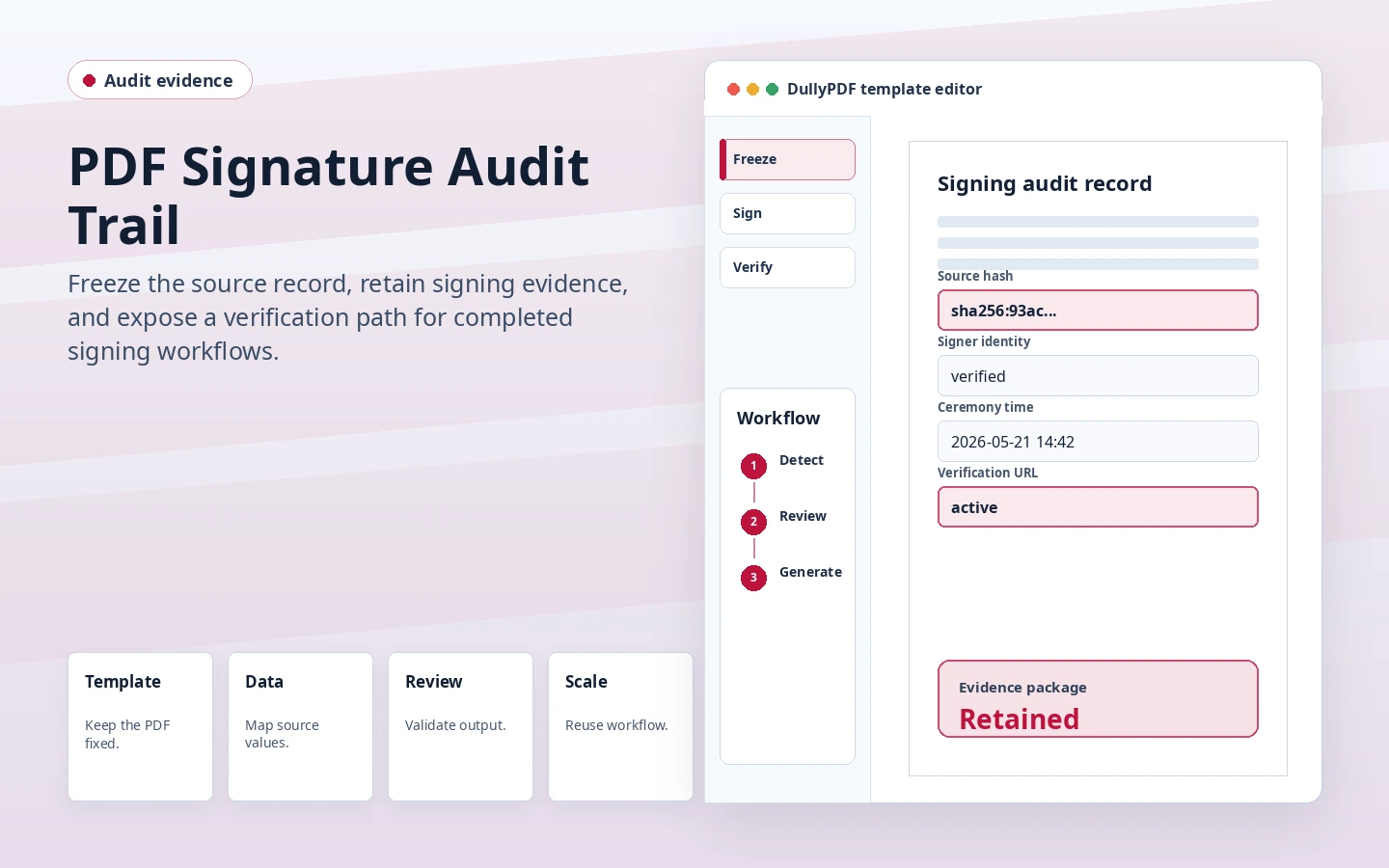
DullyPDF signature audit trail preview showing source hash, signer identity, ceremony time, and verification URL evidence.
A useful audit trail starts when the source PDF is frozen before the signing invite is sent.
DullyPDF signature audit trail preview showing retained ceremony, signer, and artifact evidence.
Completed signing workflows should retain evidence for the owner while keeping the public receipt focused and readable.

An audit trail starts before the email is sent

A useful PDF signing workflow does not begin at the signer click. It begins when the owner freezes the exact source record that the signer will review. If the source PDF can keep changing after the invite is sent, the audit story becomes weak.

DullyPDF materializes the current filled record into an immutable source artifact before the signing ceremony. That source boundary is what connects the signature to the exact record the owner intended to send.

The owner evidence is richer than the public receipt

Public recipients need a readable receipt and verification path. Owners often need more operational detail: request identifiers, source and signed hashes, sender and signer identity fields, delivery state, OTP or access-check state, ceremony timestamps, retained artifact paths, and completion metadata.

DullyPDF separates those audiences. The public receipt is intentionally narrower, while owner-side downloads expose the detailed evidence needed for internal review or dispute preparation.

Verification links are different from viewer trust badges

A PDF viewer trust badge depends on the embedded certificate chain and the viewer trust store. In development or self-signed configurations, viewers may show the embedded certificate as untrusted even when the record has a retained audit path.

DullyPDF therefore treats the retained validation page and audit artifacts as an important verification path. When production PDF-signing identity is configured, embedded cryptographic signatures can add another inspection layer.

Scope matters for legal and regulated documents

The signing workflow is designed around ordinary supported business records and core U.S. electronic-signature mechanics. It is not a universal claim that every document type can be signed through a self-serve flow.

Teams should keep excluded categories, notarization-required workflows, real-property recording, court documents, and other regulated programs outside the generic workflow unless they have completed separate policy review.

Validate the signature audit trail workflow with one real record

A useful signature audit trail test starts with one document your team already recognizes, not a perfect demo PDF. Open the existing file, review detection, rename ambiguous fields, confirm checkbox and radio behavior, and save the template only after the field list matches the way the document is used in practice.

Then fill one representative record end to end. Include long names, blank optional values, dates, yes/no choices, and any calculated or scannable fields the page depends on. That single controlled run exposes most template issues before they become repeated output problems.

Choose data and output paths for signature audit trail

Search & Fill is the right first path when an operator should pick a record and inspect the result before export. It works with row data from CSV, XLSX, JSON, or stored respondent records. SQL and TXT files should be treated as schema-only mapping inputs; database-backed production workflows should query the database elsewhere and send JSON through API Fill.

Output mode matters too. Editable PDFs are useful when someone will continue working in live fields. Flat PDFs are safer when the completed record goes to customers, employees, agencies, signers, or archive systems because the visible values are baked into the page instead of depending on the recipient PDF viewer.

Production checklist for signature audit trail

The signature audit trail workflow is ready to reuse when a teammate can clear the document, rerun the same source record, and produce the same visible PDF without remembering hidden cleanup steps. If the result depends on one person knowing which field to fix manually, the template still needs review before it belongs in a repeat workflow.

  • The saved template uses stable field names and reviewed field types.
  • Source headers or API keys match the template schema without ambiguous duplicates.
  • Checkbox, radio, calculated, image, barcode, and signature fields have been tested if the workflow uses them.
  • At least one flat output and one editable output have been opened in the PDF viewers recipients are likely to use.

Why teams use Signature Audit Trail

  • Freeze the reviewed filled PDF before sending it for signature.
  • Retain source and signed artifact metadata, ceremony timestamps, and completion evidence.
  • Expose a public verification page so recipients can re-check the retained record later.

Implementation signals for Signature Audit Trail

  • Completed signing flows expose `/verify-signing/:token` validation pages.
  • Owner audit evidence is broader than the public receipt and preserves source/signed hashes and ceremony state.
  • When configured, DullyPDF can embed a cryptographic PDF signature; otherwise the retained audit path remains the intended verification route.

Need deeper technical details about signature audit trail? Use the Rename + Mapping docs and Search & Fill docs to validate exact behavior.

Frequently asked questions about Signature Audit Trail

Does DullyPDF keep an audit trail for signed PDFs?

Yes. DullyPDF retains owner-side evidence such as source/signed hashes, request metadata, signer state, timestamps, and retained artifacts.

Can recipients verify a completed signing record later?

Yes. Completed signing flows expose a public verification page linked from the audit receipt.

Does this guarantee every document is legally valid?

No. DullyPDF supports signing workflow mechanics, but document category, jurisdiction, and policy requirements still need appropriate review.

Docs for Signature Audit Trail

Use these docs pages to verify the exact DullyPDF behavior behind signature audit trail before you ship it as a repeat workflow.

Related routes for Signature Audit Trail

These adjacent workflow pages cover nearby search intents teams compare while evaluating signature audit trail.