
Why teams use India PDF Packet Workflow
- Reuse one record across several PDFs in a packet.
- Keep shared field names consistent across templates.
- Generate grouped outputs after each template is reviewed.
India workflow page
Group multiple Indian PDF templates so one reviewed record can fill a full packet for onboarding, finance, admissions, clinic, branch, or logistics workflows.
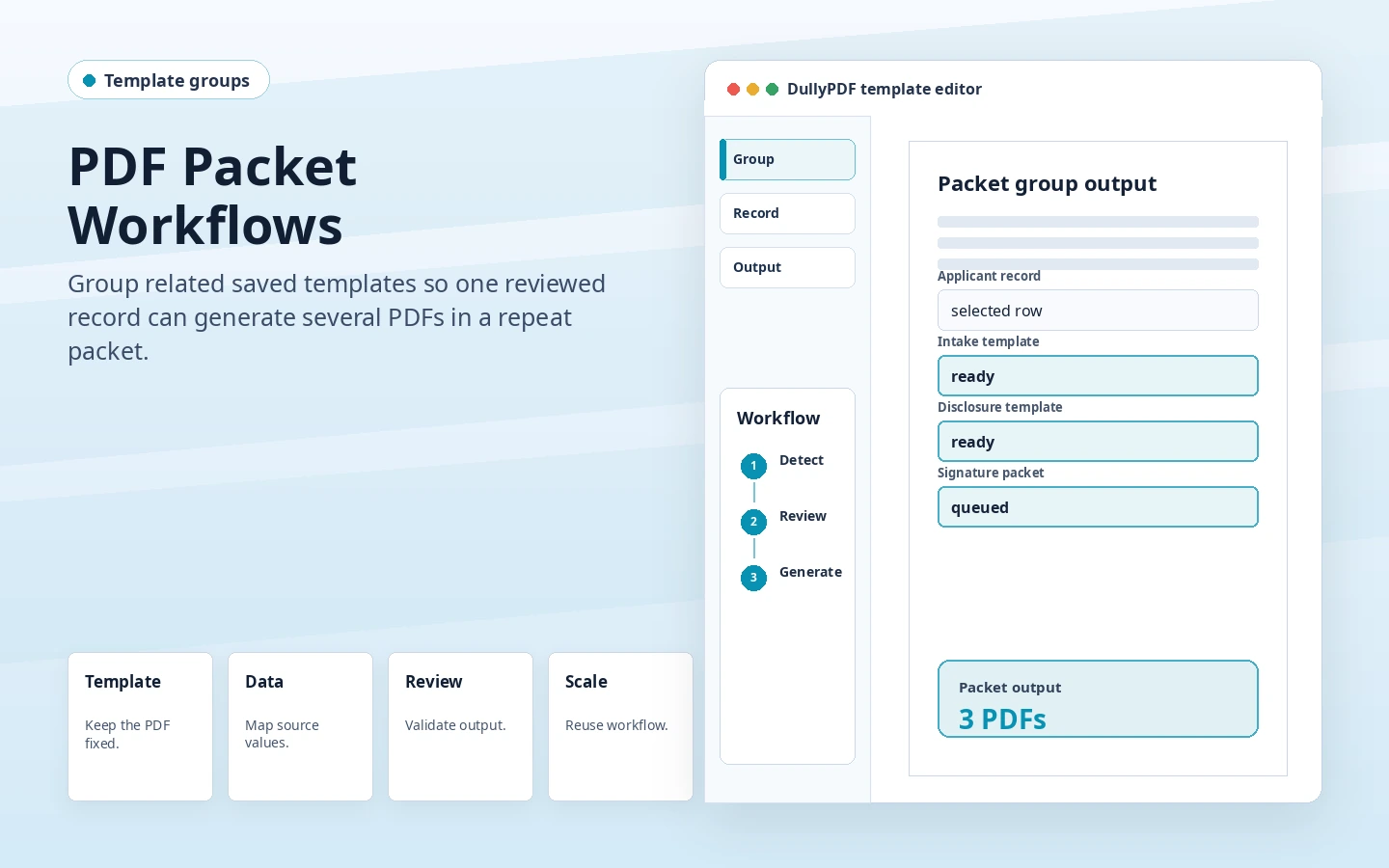
Indian paperwork often arrives as a packet, not a single form. HR joining, vendor onboarding, KYC, loan files, admissions, and clinic intake can repeat the same record across several PDFs.
Use this workflow when the recurring PDF work includes HR joining packets, vendor onboarding packets, KYC document sets, loan application packets, and school admission and clinic intake packets. The page should stay tied to real Indian operating examples rather than cloning a global workflow and swapping in country terms.
Packet work fails when each PDF is named differently. Clean and map each template, then align shared fields before expecting one row to fill the full packet.
A practical setup pass is to upload one real PDF, review detected fields, correct names and types, map the field set to source data, and save the template before inviting respondents, running a batch, or publishing an API endpoint.
Start from the source records the team already trusts: one employee row, one vendor row, one customer KYC row, one applicant record, and one student or patient intake response. Keep the mapping explicit enough that a reviewer can tell where each value came from.
Create a shared packet schema for common fields such as full_name, branch_code, pan_number, gstin, address, and reviewer_id. Each PDF can still have its own extra fields.
Search & Fill is the safest packet runtime at first because the operator can inspect output across all templates. API packet output should come after the group is stable.
Search & Fill is the safest first runtime when a staff member still needs to inspect one record. Fill By Link is better when the source data should come from a respondent. API Fill is better after an internal system can send clean JSON to a saved template.
Start with two or three PDFs that share many fields. Expanding to ten PDFs before the first shared mapping is stable creates avoidable cleanup.
Start with one high-volume Indian workflow, validate a real record, then expand into adjacent PDFs only after the first template is dependable. That gives the India workflow cluster a real reason to exist.
A packet workflow organizes output, but the team still decides which documents belong in the packet and which reviewer approves the completed set.
DullyPDF handles field detection, cleanup, mapping, reusable templates, fill output, and reviewed PDF generation. It does not replace local policy, tax review, lending decisions, medical judgment, admissions decisions, procurement approval, or document-retention rules.
Need deeper technical details about india pdf packet workflow? Use the Rename + Mapping docs and Search & Fill docs to validate exact behavior.
Yes. Use one reviewed PDF template, map it to one reviewed record shared across multiple templates, and run the workflow through Search & Fill, Fill By Link, or API Fill depending on how the source data is collected.
Use one real employee, vendor, customer, applicant, student, or patient record and fill two or three PDFs before expanding the group.
Use flat output when the packet is a final onboarding, KYC, loan, admission, clinic, or branch record that should not depend on editable fields.
These workflow pages are meant to connect product mechanics to the India industry pages where the same mechanics show up in day-to-day paperwork.
These walkthroughs and comparison posts cover the same workflow cluster from an operator point of view, which helps you move from a route summary into a more specific implementation path.
Use these docs pages to verify the exact DullyPDF behavior behind india pdf packet workflow before you ship it as a repeat workflow.
These adjacent workflow pages cover nearby search intents teams compare while evaluating india pdf packet workflow.