Commercial workflow page

Reuse Stored Fill By Link Responses as PDF Fill Sources

Treat stored respondent submissions as a structured record source for Search & Fill, packet generation, signing, or API materialization instead of one-shot downloads.

Workflow examples for Stored Link Responses

DullyPDF mock respondent form preview representing a submission record that can be reused as a fill source.
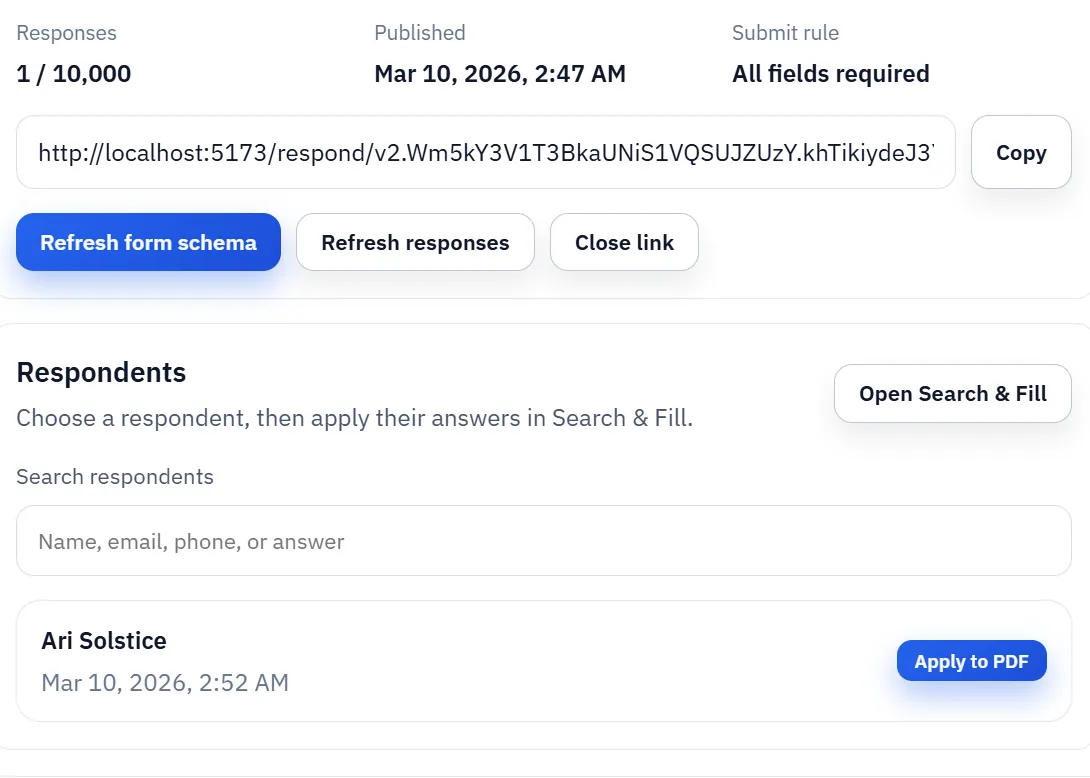
Each respondent submission stays attached to the saved template or open group instead of disappearing into a one-shot download.
DullyPDF Fill By Link generated state used to publish a hosted respondent form.
A published link collects structured responses that the owner can later treat as fill source records.

A submission is data, not just a finished PDF

Many web form tools treat each submission as a single PDF download. The PDF is the deliverable and the underlying data disappears into an email or attachment. That makes follow-up workflows harder than they need to be: every reuse means typing the same values back in.

DullyPDF keeps submissions as structured records on the saved template (or open group). Each record stays tied to its field schema, can be searched, and can be selected as the source data for any future fill against the same template.

Use Search & Fill to bring a stored response into the active workspace

Search & Fill is the natural way to drive a fresh fill from a stored response. The operator picks the submission, the template fills with those values in the active workspace, and the output can be downloaded, saved, signed, or refilled after review.

That review step matters because the stored response is now feeding a regenerated PDF. Mapped values, checkbox semantics, and signature dependencies still deserve a look before the output is treated as final.

Group submissions can drive whole packets

When the saved template lives in an open group with a merged Fill By Link, one respondent submission can feed several member templates on the owner side. That is useful for onboarding, claim, and application packets where the same record should populate multiple documents.

The group submission stays structured the same way a single-template submission does, so the owner can select it, regenerate the packet, send portions for signing, or push it through Group API Fill if a programmatic packet is needed.

Where stored responses fit and where they do not

Stored responses are useful for repeat workflows: regenerating a PDF when the source template is updated, restarting a stalled signing ceremony, exporting a packet to a new recipient, or re-running review after a mapping change. They keep the record alive without forcing every operator to be the data source.

They are not a replacement for proper records retention in regulated workflows. The audit trail for signed records lives in the signing artifacts, not in the editable response store, and stored responses should be deleted when retention policies require it.

Validate the stored link responses workflow with one real record

A useful stored link responses test starts with one document your team already recognizes, not a perfect demo PDF. Open the existing file, review detection, rename ambiguous fields, confirm checkbox and radio behavior, and save the template only after the field list matches the way the document is used in practice.

Then fill one representative record end to end. Include long names, blank optional values, dates, yes/no choices, and any calculated or scannable fields the page depends on. That single controlled run exposes most template issues before they become repeated output problems.

Choose data and output paths for stored link responses

Search & Fill is the right first path when an operator should pick a record and inspect the result before export. It works with row data from CSV, XLSX, JSON, or stored respondent records. SQL and TXT files should be treated as schema-only mapping inputs; database-backed production workflows should query the database elsewhere and send JSON through API Fill.

Output mode matters too. Editable PDFs are useful when someone will continue working in live fields. Flat PDFs are safer when the completed record goes to customers, employees, agencies, signers, or archive systems because the visible values are baked into the page instead of depending on the recipient PDF viewer.

Production checklist for stored link responses

The stored link responses workflow is ready to reuse when a teammate can clear the document, rerun the same source record, and produce the same visible PDF without remembering hidden cleanup steps. If the result depends on one person knowing which field to fix manually, the template still needs review before it belongs in a repeat workflow.

  • The saved template uses stable field names and reviewed field types.
  • Source headers or API keys match the template schema without ambiguous duplicates.
  • Checkbox, radio, calculated, image, barcode, and signature fields have been tested if the workflow uses them.
  • At least one flat output and one editable output have been opened in the PDF viewers recipients are likely to use.

Why teams use Stored Link Responses

  • Treat each submission as a structured record that can be filled into the same template later.
  • Move a stored response into Search & Fill, packet generation, signing, or API output without retyping.
  • Keep respondent data on the saved template instead of relying on email attachments or local files.

Implementation signals for Stored Link Responses

  • Saved templates and open groups expose a responses tab beside Fill By Link configuration.
  • Search & Fill can select stored Fill By Link submissions as the active record source.
  • Signing flows can materialize the filled PDF from the stored response before sending the signing invite.

Need deeper technical details about stored link responses? Use the Rename + Mapping docs and Search & Fill docs to validate exact behavior.

Frequently asked questions about Stored Link Responses

Does DullyPDF store Fill By Link submissions?

Yes. Submissions are kept on the saved template or open group and can be reused as a structured record source.

Can a stored response be used in Search & Fill?

Yes. Search & Fill can select stored Fill By Link submissions and fill the active template from those values.

Can a stored response feed a signing workflow?

Yes. Signing materializes the filled PDF from the stored response before sending the signing invite.

Can stored responses be deleted?

Yes. Owners can delete stored responses when retention policies or respondent requests require it.

Docs for Stored Link Responses

Use these docs pages to verify the exact DullyPDF behavior behind stored link responses before you ship it as a repeat workflow.

Related routes for Stored Link Responses

These adjacent workflow pages cover nearby search intents teams compare while evaluating stored link responses.