Commercial workflow page

Delete Pages From Fillable PDFs Safely

Remove instruction pages, duplicates, or obsolete sections from an active PDF while keeping field cleanup, saved-template QA, and final output review explicit.

Workflow examples for Delete Pages From Fillable PDF

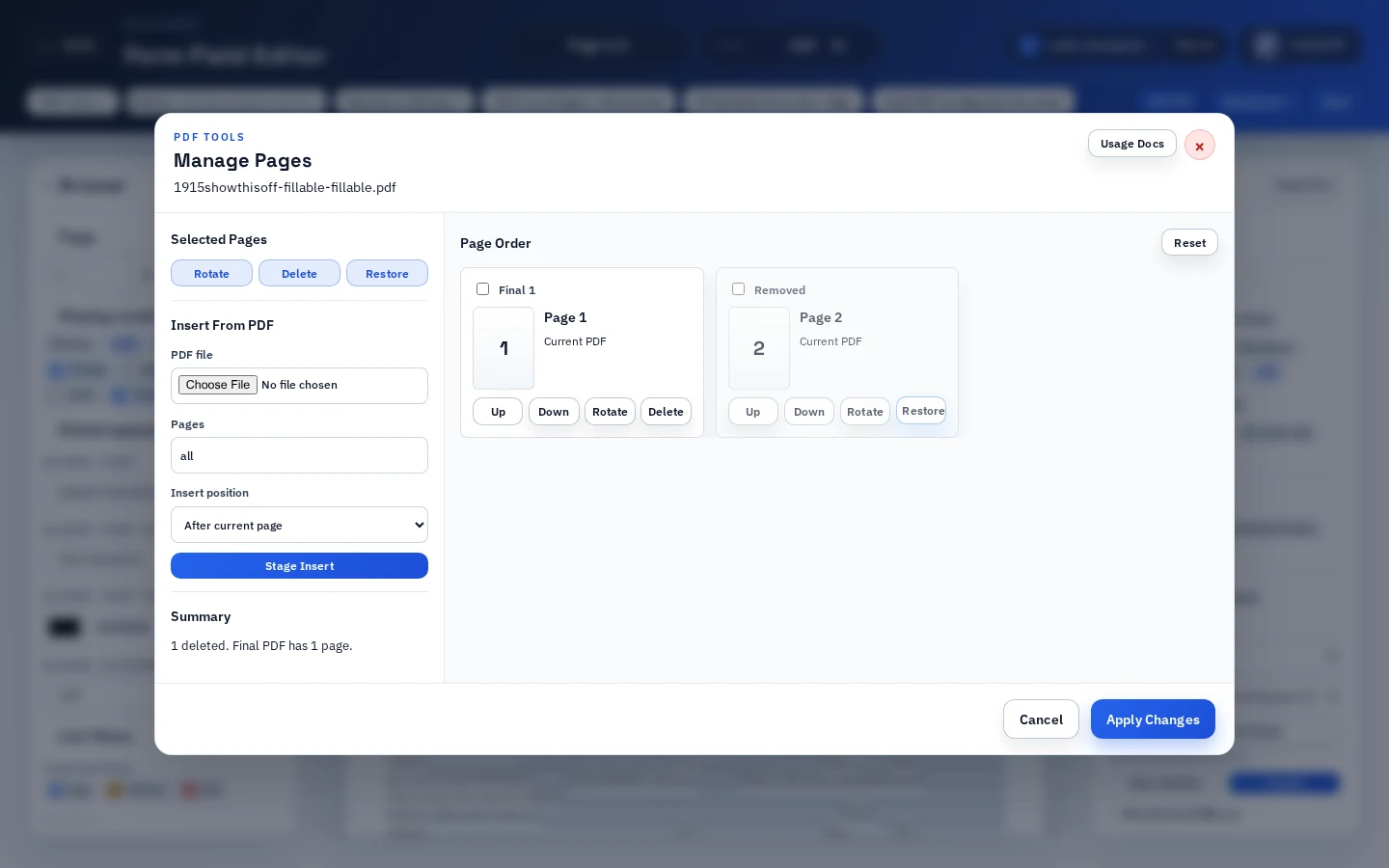
DullyPDF Manage Pages dialog showing page 2 removed from the 1915 fillable PDF.
Manage Pages stages deletion before rewriting the source PDF, so the operator can review the final page count before applying changes.
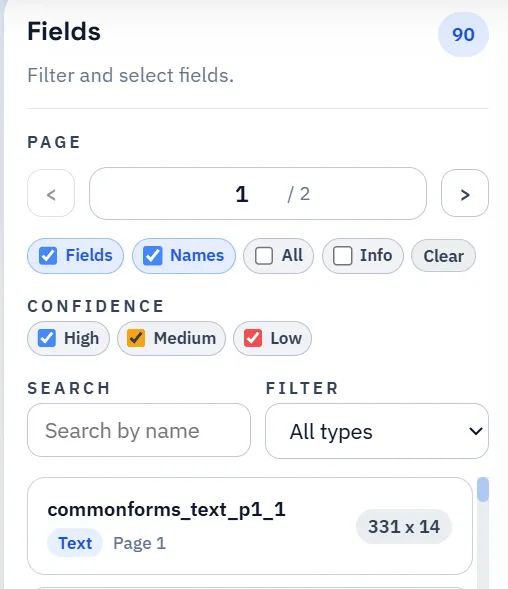
DullyPDF field list used to review remaining fields after deleting source PDF pages.
After deleting pages, review the remaining field model so stale fields, broken groups, or missing dependencies do not reach saved workflows.
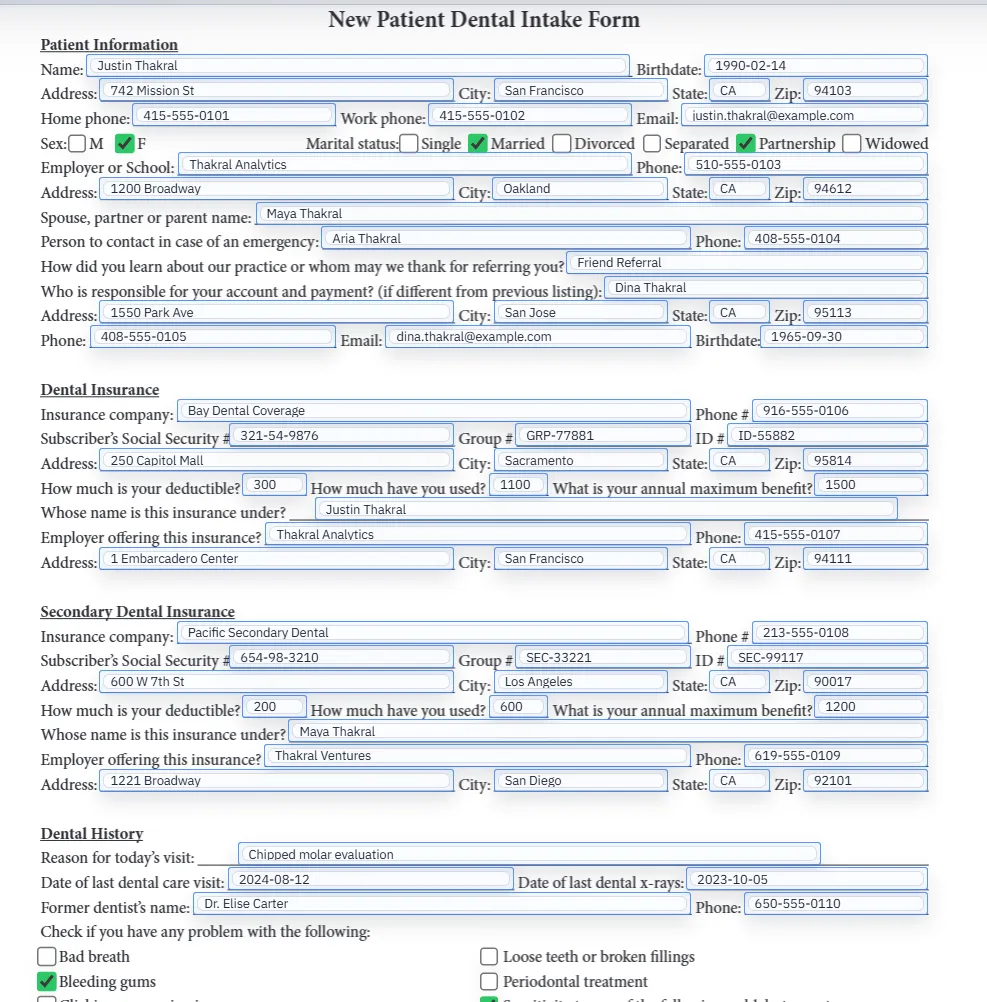
Filled PDF preview after page cleanup and field review.
Use selected-page download when only the output should omit pages; use Manage Pages when the source template should actually lose pages.

Why deleting pages from a fillable PDF is not just page cleanup

Deleting a page from an ordinary PDF is mostly a layout operation. Deleting a page from a fillable PDF template also changes the field model. Any text fields, checkbox groups, signatures, image helpers, barcode helpers, mappings, or calculated outputs on the removed page must stop participating in the workflow.

That is why DullyPDF treats page deletion as a template-editing step, not only a file-size cleanup step. The goal is to remove pages without leaving stale field metadata behind, then review the remaining template before it becomes a saved form, link, API endpoint, or signing source.

  • Best fit: removing cover pages, instruction pages, duplicates, blank pages, obsolete sections, or packet pages that should not stay in the reusable template.
  • Poor fit: hiding pages from one recipient while the source template should remain unchanged; use selected-page download for that.

Use Manage Pages when the template should permanently lose pages

The permanent delete path is PDF Tools > Manage Pages. The dialog lets the operator select pages, mark them for removal, inspect the staged final page count, reset before applying, and then rewrite the active source PDF only after the staged plan is accepted.

That staging step is important because deleting the wrong page can remove fields and context the workflow still needs. Treat the dialog like a review gate: confirm the pages, confirm the final count, and only then apply the source-PDF change.

Use Download specific pages when deletion is only an output decision

Sometimes the operator does not need to delete anything from the template. They only need a partial copy for a recipient, a supporting attachment, or an internal reviewer. In that case, Download specific pages is safer because it exports a selected page subset without changing the active workspace PDF.

That distinction keeps reusable templates stable. Delete pages when the source should change. Export selected pages when only this one output should be shorter.

  • Delete pages for permanent source cleanup.
  • Download specific pages for one-off partial output.
  • Create a separate saved template when the same trimmed document will recur.

What happens to fields on deleted pages

Fields on deleted source pages are removed from the active field set. Fields on retained pages continue with those pages, and reordered pages carry their fields into the new order. That behavior prevents the most dangerous failure mode: a saved template that still thinks a removed page has fillable fields.

The remaining fields still deserve review. After deletion, scan the field list and the visual overlay for missing context, broken group logic, orphaned calculations, or signatures that depended on the removed page.

Common pages to delete and pages to keep

Good deletion candidates are pages that do not belong in the recurring fill workflow: duplicate pages, accidental blanks, obsolete versions, local cover sheets, or instructions that your internal process stores somewhere else. Removing those pages can make the template cleaner and reduce avoidable review noise.

Be more careful with disclosure pages, signature instructions, calculation summaries, legal notices, or any page that explains a checkbox or recipient obligation. A page can be visually boring and still be necessary context for the final record.

A safe deletion checklist before saving or publishing

After applying page deletion, treat the document like a changed template. Verify the final page count, review the remaining field list, test one representative fill, and check the output mode that the next workflow will use.

That is especially important before Fill By Link, API Fill, or signing. Those workflows rely on the saved template state. If deletion removed a field that was mapped, calculated, or expected by a signer, the problem should be caught before a public link or immutable signing source depends on it.

  • Confirm the deleted pages were not required for context, signatures, calculations, or disclosures.
  • Review field names, geometry, checkbox/radio groups, image helpers, barcode helpers, and calculation dependencies.
  • Run one fill against representative data before saving, publishing, API enabling, or sending for signature.
  • Use Compress / Optimize PDF only after the page structure and fields are stable.

Compression comes after deletion, not before QA

Deleting pages may reduce the document size, but compression is still a separate cleanup step. DullyPDF Compress / Optimize PDF performs lossless cleanup and keeps the current PDF bytes when the optimized result would be larger.

Run compression after the template is stable. It should be the finishing pass on a reviewed source PDF, not a replacement for checking the remaining pages and fields.

Why teams use Delete Pages From Fillable PDF

  • Stage page deletion before rewriting the active source PDF.
  • Remove fields that belonged to deleted pages instead of leaving stale template metadata behind.
  • Use selected-page download when you only need a partial output and should not mutate the template.

Implementation signals for Delete Pages From Fillable PDF

  • Manage Pages supports staged delete, reorder, rotate, and insert-from-PDF operations before applying source-PDF changes.
  • When a source page is deleted, DullyPDF removes fields on that page from the active field set.
  • The final page plan must keep at least one page before changes can be applied.
  • After page changes, DullyPDF refreshes the active PDF bytes and backend session when possible so Rename/Map can continue against the updated document.

Need deeper technical details about delete pages from fillable pdf? Use the Rename + Mapping docs and Search & Fill docs to validate exact behavior.

Frequently asked questions about Delete Pages From Fillable PDF

Can DullyPDF delete pages from a fillable PDF?

Yes. Use PDF Tools > Manage Pages to select pages, mark them for deletion, and apply the staged source-PDF update.

What happens to fields on deleted pages?

Fields on deleted source pages are removed from the active field set so the template does not retain stale fields for pages that no longer exist.

Should I delete pages or download specific pages?

Delete pages when the source template itself should change. Use Download specific pages when you only need a one-off partial output.

Can I delete instruction pages from an official form?

Only if your workflow no longer needs those pages. Keep instruction, disclosure, signature, or legal-context pages when they are required for the final record.

Can deleted-page templates still be used for Fill By Link, API Fill, or signing?

Yes, after reviewing and saving the updated template. Run at least one representative fill before publishing or freezing the document for signature.

Deletion should stay tied to template review

Page deletion is safest when it is followed by the same review steps as any other template change: field cleanup, representative fill, output check, and then save or publish.

Docs for Delete Pages From Fillable PDF

Use these docs pages to verify the exact DullyPDF behavior behind delete pages from fillable pdf before you ship it as a repeat workflow.

Related routes for Delete Pages From Fillable PDF

These adjacent workflow pages cover nearby search intents teams compare while evaluating delete pages from fillable pdf.