Industry workflow page

Manufacturing PDF Automation for Quality, Work Orders, and Lot Records

Build highly customizable manufacturing PDF templates with lot barcodes, inspection fields, yield calculations, defect counts, and final flat PDF records.

Workflow examples for Manufacturing PDF Automation

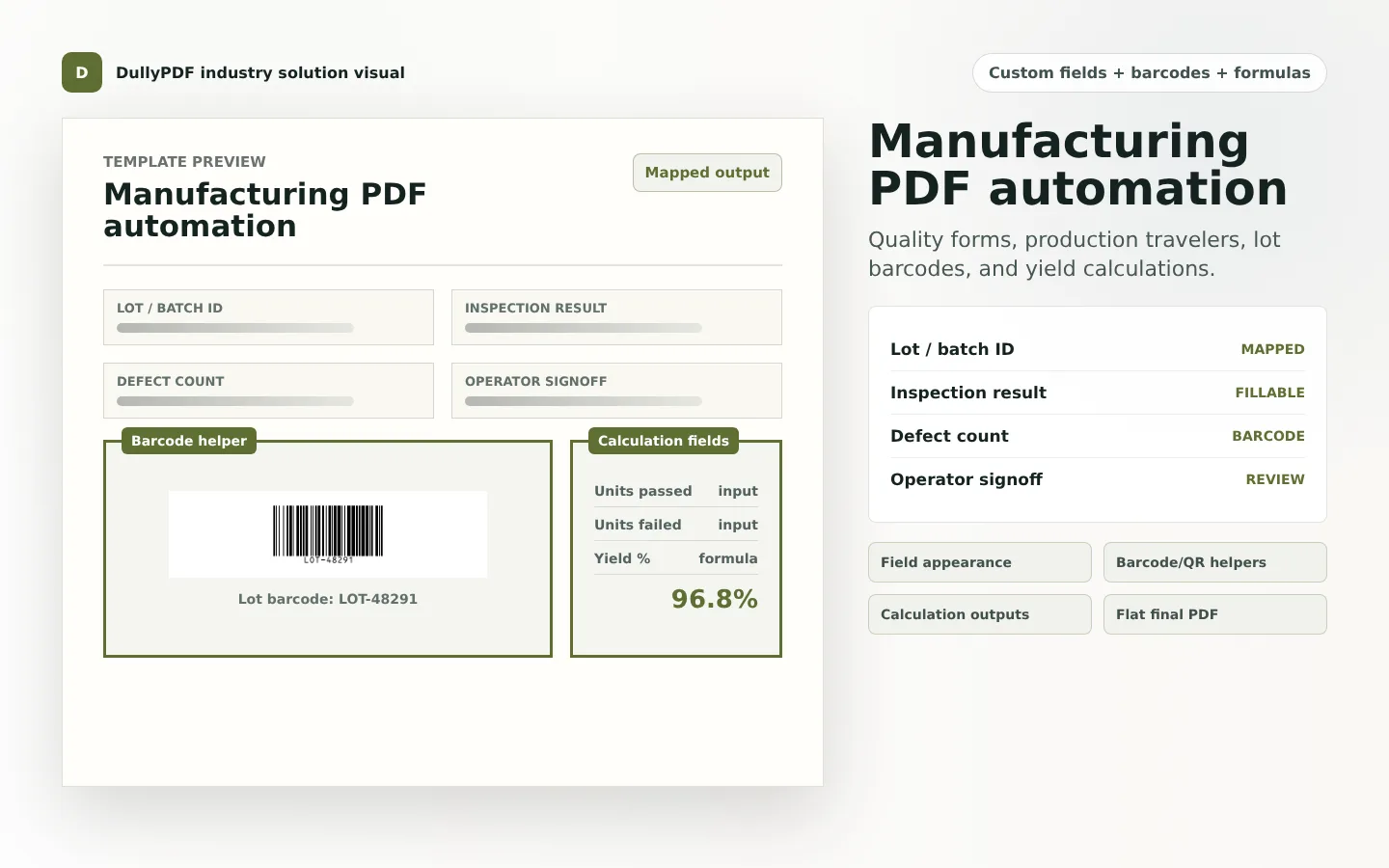
A manufacturing PDF template preview showing lot barcode, inspection fields, defect count, and yield calculation output.
Manufacturing templates often need custom fields, lot or batch barcodes, and calculated quality metrics in one reviewed PDF layout.
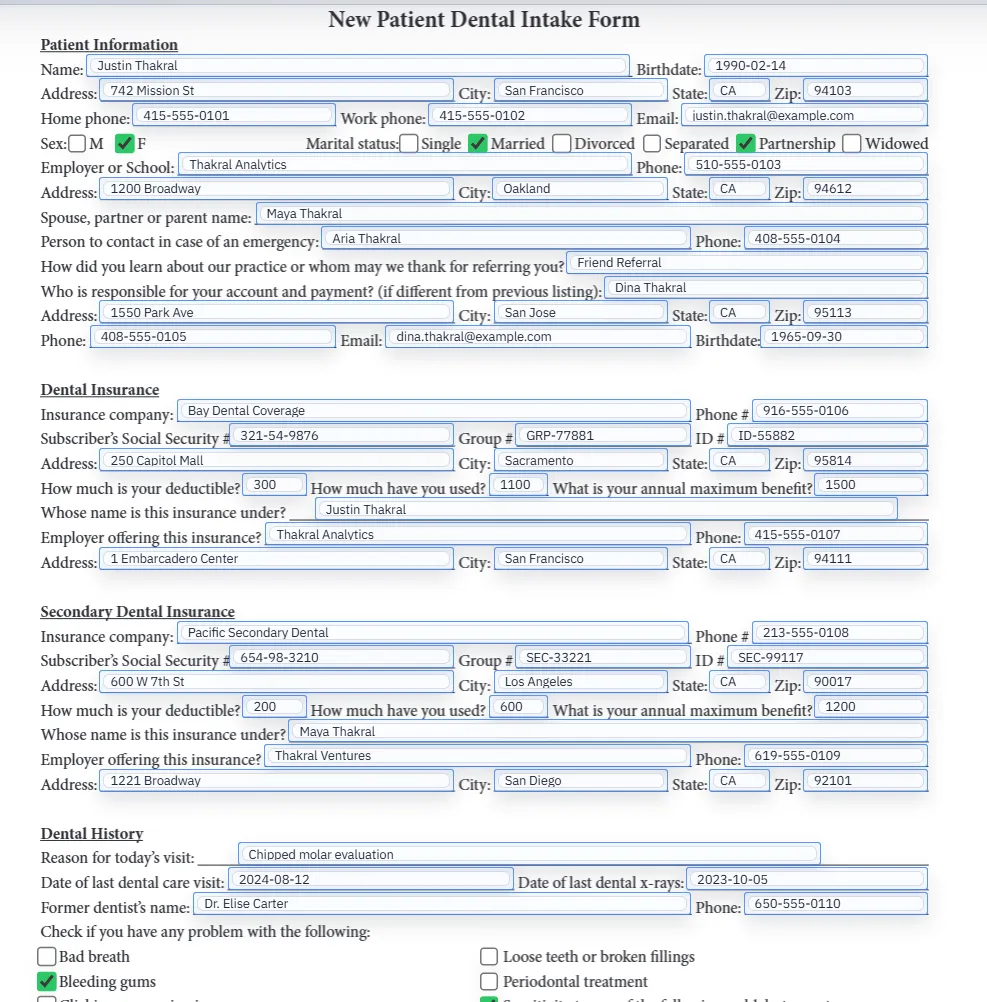
Filled PDF preview representing a final manufacturing PDF output after mapped quality values have been applied.
Inspection and quality forms become easier to reuse when score, pass rate, and yield outputs are calculated from source inputs.

Why manufacturing PDFs need more than basic text boxes

Manufacturing paperwork often combines several field types in one record: text fields for part and lot details, checkboxes for quality gates, signatures for operator review, barcodes for lot or serial lookup, and calculated outputs for yield or defect rate. A generic fillable PDF editor can create boxes, but it usually does not model the workflow behind those boxes.

DullyPDF is a stronger fit when the plant already has fixed PDFs and needs a reusable template layer on top. The source layout stays stable, while the template captures field geometry, names, helper codes, formulas, and export behavior.

Barcode fields for lots, serials, and production travelers

Manufacturing teams can use 1D barcode helpers for short lot, batch, serial, or work-order IDs. QR codes fit better when the PDF should open a record URL, inspection portal, or traceability page. PDF417 can work when a dense structured payload needs to travel with the page.

The important rule is alignment: the code should be generated from the same mapped value visible elsewhere on the form. A pasted barcode image can drift from the printed record, while a DullyPDF helper field stays connected to template data.

Calculation fields for quality and production math

Manufacturing templates often need simple but important math: units passed, units failed, scrap count, yield percentage, rework quantity, inspection score, or labor totals. DullyPDF calculation fields let the template own those formulas instead of asking each operator or caller to type a derived value manually.

Adobe documents calculation fields and calculation order in Acrobat because dependent form math needs a predictable sequence.2 DullyPDF uses a structured formula model and precomputes values before final output, which is usually safer for final records.

How to phase a manufacturing template rollout

Start with one high-volume form: a production traveler, first article inspection, nonconformance report, or equipment checklist. Clean the ordinary fields first, then add barcode helpers and calculation outputs. Test one realistic record, one missing-data record, and one edge-case record before publishing the template.

After that, expand to adjacent forms. A small library of trusted manufacturing templates is more useful than dozens of half-configured PDFs that operators do not trust.

Validate the manufacturing pdf automation rollout with one real record

A useful manufacturing pdf automation test starts with one document your team already recognizes, not a perfect demo PDF. Open the existing file, review detection, rename ambiguous fields, confirm checkbox and radio behavior, and save the template only after the field list matches the way the document is used in practice.

Then fill one representative record end to end. Include long names, blank optional values, dates, yes/no choices, and any calculated or scannable fields the page depends on. That single controlled run exposes most template issues before they become repeated output problems.

Choose data and output paths for manufacturing pdf automation

Search & Fill is the right first path when an operator should pick a record and inspect the result before export. It works with row data from CSV, XLSX, JSON, or stored respondent records. SQL and TXT files should be treated as schema-only mapping inputs; database-backed production workflows should query the database elsewhere and send JSON through API Fill.

Output mode matters too. Editable PDFs are useful when someone will continue working in live fields. Flat PDFs are safer when the completed record goes to customers, employees, agencies, signers, or archive systems because the visible values are baked into the page instead of depending on the recipient PDF viewer.

Production checklist for manufacturing pdf automation

The manufacturing pdf automation rollout is ready to reuse when a teammate can clear the document, rerun the same source record, and produce the same visible PDF without remembering hidden cleanup steps. If the result depends on one person knowing which field to fix manually, the template still needs review before it belongs in a repeat workflow.

  • The saved template uses stable field names and reviewed field types.
  • Source headers or API keys match the template schema without ambiguous duplicates.
  • Checkbox, radio, calculated, image, barcode, and signature fields have been tested if the workflow uses them.
  • At least one flat output and one editable output have been opened in the PDF viewers recipients are likely to use.

Why teams use Manufacturing PDF Automation

  • Turn production travelers, inspection records, nonconformance forms, and batch paperwork into reusable PDF templates.
  • Add lot, batch, serial, or work-order barcode helper fields tied to the same data that fills the PDF.
  • Use calculation fields for yield, defect rate, score, quantity, labor, and final-review totals.

Implementation signals for Manufacturing PDF Automation

  • DullyPDF supports customizable field appearance, image helpers, barcode helpers, and calculation fields in saved templates.
  • GS1 explains barcode types across 1D and 2D codes, which helps manufacturing teams choose between short IDs and richer lookup links.
  • Flat output is useful for final quality records because completed values and generated codes are baked into the page.

Need deeper technical details about manufacturing pdf automation? Use the Rename + Mapping docs and Search & Fill docs to validate exact behavior.

Frequently asked questions about Manufacturing PDF Automation

Can DullyPDF automate manufacturing quality PDFs?

Yes. Manufacturing teams can create reusable templates with field cleanup, barcode helpers, image fields, calculation outputs, and flat final PDF exports.

Can manufacturing PDFs include lot or serial barcodes?

Yes. DullyPDF supports 1D barcode, QR Code, and PDF417 helper fields depending on whether the code should carry a short ID, URL, or denser payload.

Can DullyPDF calculate yield or defect rate on a PDF?

Yes. Calculation fields can compute derived outputs from source number inputs before the PDF is generated.

Legal footnotes and sources for Manufacturing PDF Automation

  1. 1.GS1 US | Barcode types and 1D/2D barcode guidance
  2. 2.Adobe Acrobat Help | Configure form fields for calculations

Docs for Manufacturing PDF Automation

Use these docs pages to verify the exact DullyPDF behavior behind manufacturing pdf automation before you ship it as a repeat workflow.

Related routes for Manufacturing PDF Automation

These adjacent routes cover neighboring document workflows and team use cases that usually get evaluated alongside manufacturing pdf automation.