Commercial workflow page

No-Code PDF Automation for Existing Forms

Build repeat PDF workflows from existing documents with field detection, AI rename and mapping, Search & Fill, Fill By Link, API Fill, groups, and signing.

Workflow examples for No-Code PDF Automation

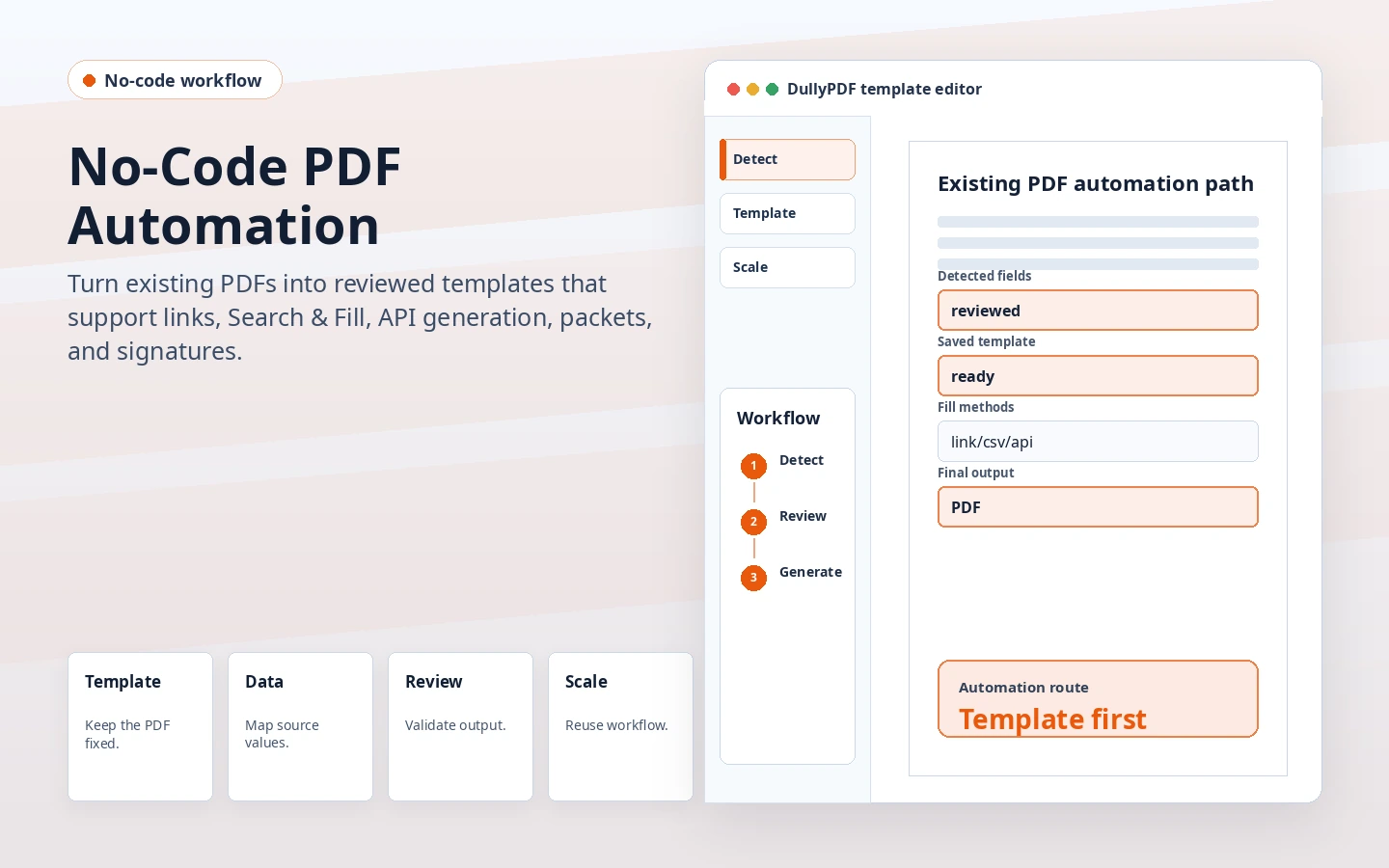
DullyPDF no-code PDF automation preview showing detected fields, saved template state, fill methods, and final output.
No-code PDF automation still begins with a reviewed field model, not blind document output.
Respondent-facing DullyPDF web form generated from a saved PDF template.
Once the template is trusted, it can support respondent collection, row-based fill, API generation, groups, or signing.

No-code does not mean no review

The strongest no-code PDF workflows still have a setup discipline. A person needs to confirm that detected fields are real, names are clear, checkbox and radio behavior is explicit, mappings line up with source data, and the final PDF looks right.

DullyPDF is built around that reality. It reduces manual field creation and repeated data entry, but it keeps review visible because recurring PDFs usually carry operational consequences.

Start from existing PDFs, not blank app screens

Many teams already have the PDF that customers, agencies, vendors, employees, or partners expect. Rebuilding the workflow from scratch can create a second version of the form and a new maintenance problem.

DullyPDF works best when the source PDF layout should remain intact. The automation layer sits around the document: field detection, mapping, filling, collection, API generation, and signing.

Choose the workflow after the template works

A working template can support several next steps. Search & Fill is best for operator-controlled review. Fill By Link is best for external respondents. API Fill is best for system-generated PDFs. Groups are best for packets. Signing is best after the filled record is frozen.

Those workflow choices should come after one representative fill succeeds. Publishing too early only spreads template mistakes into more places.

Where a different tool is better

DullyPDF is not a full page-design editor, a dynamic document-generation engine for arbitrary page growth, or a replacement for legal, tax, medical, payroll, or compliance review. It is a focused workflow tool for recurring PDFs with stable layouts.

That focus is what makes the no-code claim practical. It should win the jobs where existing PDFs need repeatable field operations, not every document task on the market.

Validate the no-code pdf automation workflow with one real record

A useful no-code pdf automation test starts with one document your team already recognizes, not a perfect demo PDF. Open the existing file, review detection, rename ambiguous fields, confirm checkbox and radio behavior, and save the template only after the field list matches the way the document is used in practice.

Then fill one representative record end to end. Include long names, blank optional values, dates, yes/no choices, and any calculated or scannable fields the page depends on. That single controlled run exposes most template issues before they become repeated output problems.

Choose data and output paths for no-code pdf automation

Search & Fill is the right first path when an operator should pick a record and inspect the result before export. It works with row data from CSV, XLSX, JSON, or stored respondent records. SQL and TXT files should be treated as schema-only mapping inputs; database-backed production workflows should query the database elsewhere and send JSON through API Fill.

Output mode matters too. Editable PDFs are useful when someone will continue working in live fields. Flat PDFs are safer when the completed record goes to customers, employees, agencies, signers, or archive systems because the visible values are baked into the page instead of depending on the recipient PDF viewer.

Production checklist for no-code pdf automation

The no-code pdf automation workflow is ready to reuse when a teammate can clear the document, rerun the same source record, and produce the same visible PDF without remembering hidden cleanup steps. If the result depends on one person knowing which field to fix manually, the template still needs review before it belongs in a repeat workflow.

  • The saved template uses stable field names and reviewed field types.
  • Source headers or API keys match the template schema without ambiguous duplicates.
  • Checkbox, radio, calculated, image, barcode, and signature fields have been tested if the workflow uses them.
  • At least one flat output and one editable output have been opened in the PDF viewers recipients are likely to use.

Why teams use No-Code PDF Automation

  • Start from PDFs your team already uses instead of rebuilding every form in a web-form builder.
  • Use focused setup steps: detect fields, clean names, map schema, test one record, then publish only what is ready.
  • Choose the right output path for each workflow: manual review, respondent collection, API generation, packet groups, or signing.

Implementation signals for No-Code PDF Automation

  • The main pipeline runs CommonForms detection, optional OpenAI rename, schema mapping, editor review, and Search & Fill.
  • Saved templates can support Fill By Link, API Fill, grouped packets, and signing workflows.
  • Public docs and intent pages route users into focused setup guides instead of treating every workflow as one generic feature.

Need deeper technical details about no-code pdf automation? Use the Rename + Mapping docs and Search & Fill docs to validate exact behavior.

Frequently asked questions about No-Code PDF Automation

Can DullyPDF automate existing PDF forms without code?

Yes. Operators can upload an existing PDF, detect fields, clean the template, map data, and reuse it without writing code.

Can developers still use DullyPDF programmatically?

Yes. API Fill publishes saved templates as JSON-to-PDF endpoints when a programmatic workflow is the right fit.

Is DullyPDF a full document design tool?

No. DullyPDF is focused on existing PDFs, field workflows, filling, collection, API generation, packets, and signing.

Docs for No-Code PDF Automation

Use these docs pages to verify the exact DullyPDF behavior behind no-code pdf automation before you ship it as a repeat workflow.

Related routes for No-Code PDF Automation

These adjacent workflow pages cover nearby search intents teams compare while evaluating no-code pdf automation.