
Federal Employment and Security Clearance Form Packet Automation
Federal employment and investigation paperwork can include declarations for employment, appointment affidavits, veterans preference applications, public-trust questionnaires, national-security questionnaires, personnel actions, and medical-exam forms. DullyPDF can help with PDF preparation and review, but hiring, suitability, investigation, and clearance decisions remain with the responsible agency.

Federal employment packets repeat applicant identity, employment history, preference, investigation, and signer data
A federal onboarding or investigation workflow can involve OF-306, SF-61, SF-15, SF-52, SF-85P, SF-85P-S, SF-86, and OF-178. These forms collect different levels of detail, but names, addresses, identifiers, employment history, military service, education, contacts, signer details, and agency references can repeat.
Because these forms are sensitive, DullyPDF should be used as a controlled preparation and review layer only. It does not determine federal employment eligibility, veterans preference, suitability, public trust eligibility, clearance eligibility, medical qualification, or agency submission method.
Start with the employment, preference, appointment, and investigation forms your agency workflow actually uses
A practical first template library should be scoped to the role and agency process. OF-306, SF-61, SF-15, and SF-52 are employment and personnel-action oriented. SF-85P and SF-85P-S support public trust investigations. SF-86 supports national security positions. OF-178 supports medical examination workflows.
Do not treat these forms as casual intake forms. Long investigation questionnaires contain highly sensitive personal data. Use non-production test records for template validation, lock down who can access saved templates and responses, and verify the official OPM or agency source before use.


- OF-306 - Declaration for Federal Employment, 3 pages in the current catalog entry.
- SF-85P - Questionnaire for Public Trust Positions, 95 pages in the current catalog entry.
- SF-85P-S - Supplemental Questionnaire for Selected Positions, 16 pages in the current catalog entry.
- SF-86 - Questionnaire for National Security Positions, 136 pages in the current catalog entry.
- SF-15 - Application for 10-Point Veterans Preference, 2 pages in the current catalog entry.
- SF-61 - Appointment Affidavits, 1 page in the current catalog entry.
- OF-178 - Certificate of Medical Examination, 7 pages in the current catalog entry.
Use an applicant schema, but treat investigation data as sensitive controlled content
The schema should separate applicant identity, employment history, residence history, education, references, military service, preference claim, agency action, and medical-exam data. Those categories should not collapse into generic rows because each form asks about different time periods and contexts.
For long forms like SF-85P and SF-86, template validation should focus on navigation and review rather than blind automation. A team should prove that generated values land in the right section, that long narratives fit, and that the final PDF is reviewed by the responsible human before any agency process uses it.
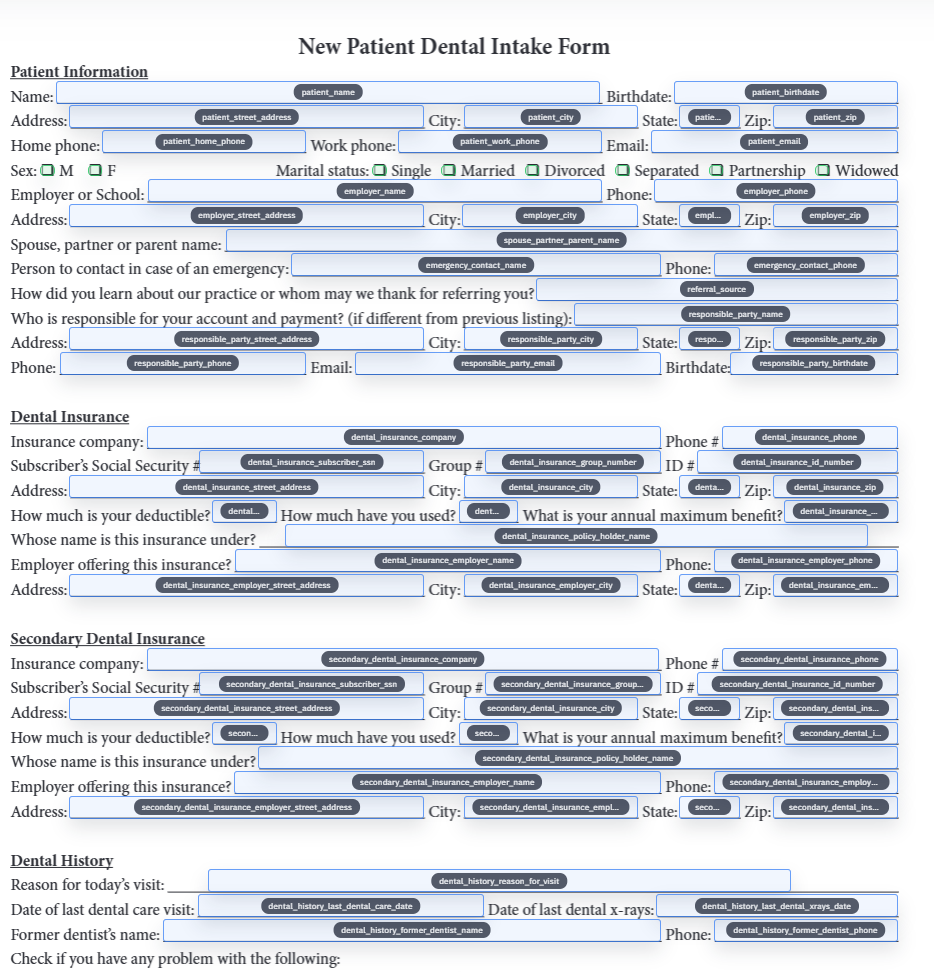
- Applicant fields: `applicant_full_name`, `date_of_birth`, `place_of_birth`, `current_address`, `contact_phone`.
- History fields: `residence_1_address`, `employment_1_employer`, `education_1_school`, `reference_1_name`.
- Federal employment fields: `agency_name`, `position_title`, `announcement_number`, `appointment_date`, `personnel_action_reason`.
- Preference fields: `veterans_preference_claimed`, `service_connected_disability_percent`, `supporting_document_reference`.
- Medical fields: `examiner_name`, `exam_date`, `medical_limitation_summary`, `certificate_signature_date`.
OPM and the requesting agency control form use, submission, and decisions
DullyPDF can prepare templates, collect or import values, fill PDFs, and export review copies. It does not conduct background investigations, verify facts, decide suitability, grant clearances, determine veterans preference, or submit forms to agency systems.
Before using a completed packet, verify the current OPM form source, agency instructions, electronic investigation system requirements, privacy notices, signature requirements, and data-handling rules.